

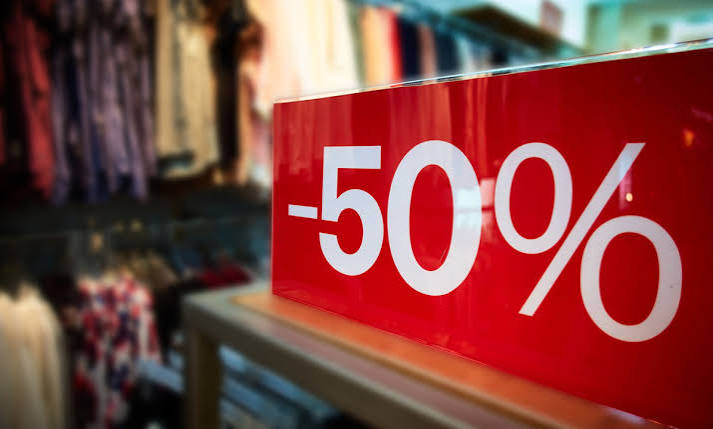
There was a time when a sale indicated something specific: the end of a season, excess inventory that needed to be cleared, or an annual shopping event such as Black Friday. The regular price was understood to be the price, and the markdown represented a genuine, temporary departure from it.
That distinction has become increasingly difficult to make.
Today, consumers routinely encounter welcome discounts for visiting a website, offers for joining an email or text list, abandoned-cart codes, Friends & Family events, private sales, influencer codes, holiday promotions and end-of-season markdowns. Black Friday has expanded from a single day into a promotional period that can consume much of November. In some categories, buying something at its listed price can begin to feel less like paying the normal price and more like failing to find the available discount.
The problem is that discounts no longer necessarily mean that a consumer is getting a deal. A percentage reduction tells us only that the current selling price is lower than the reference price presented beside it; it tells us nothing about whether that original price was reasonable, whether the current price represents good value, or whether the product was ever expected to sell consistently at its stated full price. As discounting has become embedded in modern retail, the distinction between a genuine markdown and a price designed to create the perception of a markdown has become increasingly important.
The $700 Bag Example
Consider a handbag with a fair retail price of $700, inclusive of the costs and reasonable markups required to design, manufacture, market, distribute and support it.
Company A prices the bag at $1,000, while Company B prices it at $700 from the beginning. Company A can then advertise 10% off, 20% off, and eventually 30% off, bringing its $1,000 bag down to $700. Company B continues selling its bag for $700 because that was the price that was appropriate from the start.
Although both customers ultimately pay exactly $700, the transactions feel remarkably different. The Company B customer has simply paid $700 for a $700 bag, while the Company A customer believes she has acquired a $1,000 bag for $700 and saved $300 in the process. Company A may consequently attract more attention and generate a stronger perception of value even though the final selling price is exactly the same.
This is the psychology of price anchoring at work. Once $1,000 has been established as the reference point, the consumer no longer evaluates $700 entirely on its own merits; she evaluates it in relation to the larger number she has already seen. The discount itself becomes part of what she believes she is buying.
There is an important difference between marking down a product for a legitimate commercial reason and pricing products intentionally high for the purpose of marking it down later. One can be a necessary and healthy part of retail. The other can distort a consumer's perception of value and place businesses that price fairly from the beginning at a competitive disadvantage.
That distinction is at the heart of the problem with modern discount culture.

When the Deal Becomes the Product
A piece of furniture listed at $2,500 and perpetually offered for $1,750 may appear to be a better value than a comparable piece priced at $1,750 from the beginning. A skincare set with a stated value of $300 offered for $195 immediately gives the consumer a reference point against which to judge the purchase, even though the more useful question is whether the products themselves are worth $195. A retailer that regularly offers 25% off everything on its website may generate considerably more urgency than a competitor whose everyday prices are already approximately 25% lower.
In each case, the consumer sees two numbers and is encouraged to focus on the distance between them.
This is where the psychology of a deal can become more powerful than the economics of the purchase itself. The larger the apparent savings, the easier it is to shift the consumer's attention away from the question of absolute value and toward the emotional satisfaction of having obtained something for less than someone says it was worth.
For retailers, this can be enormously effective. For the broader industry, however, there is a cost.

Businesses that establish realistic prices from the beginning are forced to compete against the psychological appeal of manufactured savings. The $700 bag priced at $700 has no crossed-out number beside it, no dramatic percentage reduction and no countdown reminding the consumer that the opportunity will disappear at midnight. It simply asks to be evaluated at $700.
When the competing $700 purchase arrives wrapped in the psychology of a $300 saving, straightforward pricing can paradoxically become the harder proposition to sell.
Retailers Have Trained Consumers to Wait
Repeated promotions also change consumer behavior over time.
If a retailer offers 25% off every Memorial Day, Labor Day, Black Friday and holiday season, a customer considering a non-urgent $500 purchase has little incentive to pay $500. Experience has taught her that patience will probably reduce the price to $375.
The same principle applies to increasingly sophisticated digital promotions. If placing an item in a cart and leaving the website reliably generates a discount code the following day, checking out immediately becomes the more expensive behavior. If signing up for text messages produces 15% off, purchasing before signing up makes little economic sense. If a brand discounts a new collection shortly after launching it, customers learn that enthusiasm at launch may carry a financial penalty.
The difficulty is that businesses then begin responding to the behavior they helped create. As more customers wait, full-price conversion declines, making promotions increasingly attractive as a way to stimulate demand. Those promotions reinforce the customer's decision to wait, which creates further pressure on full-price sales. Eventually, businesses can find themselves dependent on the promotional behavior that contributed to the problem in the first place.
This dynamic also affects retailers that never intended to participate in it. Once consumers become accustomed to seeing 20%, 30% and 40% discounts throughout a category, the absence of a promotion can make another company's fairly established price appear comparatively expensive.
At that point, discount culture has stopped being a promotional strategy employed by individual companies and has begun influencing the pricing dynamics of an entire market.
Legitimate Discounts Can Exist
There are legitimate reasons for markdowns. Retail is an inventory business, and forecasting demand with perfect accuracy can be impossible. A company may order too much of a particular style, discover that one color performs poorly, discontinue a collection or need to clear seasonal merchandise to make room for new inventory. Converting those products into cash at a lower margin can be a completely rational decision.
There are equally legitimate strategic reasons for promotions. A first-purchase offer may encourage a customer to try an unfamiliar brand. A loyalty benefit may reward an established customer relationship. A temporary promotion may be used to introduce a new category or create demand during a traditionally slower period.
These practices are fundamentally different from creating an inflated reference price primarily so that the eventual selling price can be presented as a bargain.
The distinction matters because the objective of a legitimate markdown is generally to change the selling price in response to a commercial circumstance. The objective of manufactured discounting is to change the consumer's perception of the selling price. Conflating the two makes it too easy to describe every promotion as manipulative, which is neither accurate nor particularly useful. The more important question is whether the original price was established in good faith and whether the product had a meaningful opportunity to sell at that price.
The Industry Has a Trust Problem
Once consumers begin assuming that another discount is always coming, full price itself becomes less credible.
A consumer encountering a $1,000 product may begin mentally discounting it before the retailer does. Rather than asking whether the product is worth $1,000, she may wonder whether it will be $800 next month or $700 during Black Friday. The stated price has stopped functioning as reliable information and has become the opening position in an anticipated negotiation.
That is damaging for consumers as well. A marketplace filled with inflated reference prices and perpetual promotions makes comparison more difficult because the consumer must determine which prices should be believed in the first place.
Pricing fairly from the start would not require every retailer to use the same margins, eliminate promotions or disclose proprietary cost structures. Businesses operate with different overhead, production volumes, distribution models, service levels and brand positions, all of which legitimately influence price. A fair price is not synonymous with the lowest possible price. It means establishing prices that the business genuinely intends to charge and can reasonably defend, rather than treating consumers as emotional yo-yos whose perception of value can be repeatedly manipulated by raising and lowering prices.
Consumers Can Change the Dynamic Too
The simplest defense against pricing psychology is to stop treating the size of a discount as evidence of the size of a deal.
A product that was supposedly $1,000 yesterday and costs $600 today should be evaluated as a $600 purchase. Is it worth $600 compared with other products available for approximately the same amount? What is it made from? How was it manufactured? What level of design, construction and service supports the price? Does the retailer regularly sell the product for $1,000, or does it appear to spend much of its life on promotion? Would the product still be desirable if there were no crossed-out number beside it? These questions do more to establish value than a 40% badge ever could.
Consumers should also be willing to reward companies that price consistently. If two comparable products ultimately cost the same amount, the business that established a reasonable price from the beginning shouldn't be placed at a disadvantage simply because its competitor created a larger number to cross out.
That requires a subtle change in the way a good deal is understood. Saving $300 is valuable only if $300 has genuinely been saved. A retailer's reference price cannot establish that fact on its own.
Full Price Must Also Be Earned
Fair pricing requires accountability from businesses as much as discernment from consumers. A company cannot declare itself a full-price business and expect that philosophy alone to justify what it charges. If a retailer asks consumers to trust its stated prices, those prices should withstand reasonable scrutiny.
That means giving customers enough information to evaluate what they are purchasing, particularly in categories where quality can be difficult to assess from an image. Materials, construction, manufacturing, design, durability, service and other meaningful product attributes should support the proposition being made.
This is especially relevant in luxury, where the cost of an object cannot reasonably be reduced to the sum of its raw materials. Product development, skilled craftsmanship, prototypes, quality control, specialized components, inventory risk, distribution, service and brand development are legitimate parts of the economics of producing and selling luxury goods. A higher price can therefore be entirely rational without corresponding to a simple materials-plus-markup calculation.
But a luxury label cannot substitute for value either. If businesses want consumers to become more thoughtful about discounts, businesses must be equally thoughtful about the prices they ask consumers to trust.

A Better Retail Relationship
Retailers should establish prices with the intention of actually selling products at those prices, preserve promotions for circumstances in which a genuine promotional reason exists, and resist using inflated reference prices simply to manufacture a sense of savings. Consumers can become more skeptical of crossed-out prices, compare products according to their actual selling prices and reward businesses whose pricing remains consistent.
Silver & Riley has chosen to operate primarily as a full-price business within that framework. Products are priced with the intention of selling them at their stated prices, based on the design, materials, craftsmanship, production, service and economics required to bring them to market. Promotions may occasionally serve a legitimate business purpose, but prices are not intentionally inflated simply to create room for a perpetual cycle of dramatic markdowns.
A sale should still be able to mean something. A full price should mean something too.
The next time an item appears at 20%, 30% or 40% off, perhaps the most useful question is whether the product is worth the amount being asked for today, and whether the price that has been crossed out was ever meaningful in the first place.




Leave a comment
This site is protected by hCaptcha and the hCaptcha Privacy Policy and Terms of Service apply.