
Is Luxury Worth It? The Truth About Italian Craftsmanship vs. Mass Production
Every luxury buyer eventually confronts the same question: what makes a well-crafted product worth its price? The answer lies in understanding the production systems behind it. Mass manufacturing and Italian artisanal craftsmanship operate according to entirely different logics. One is built for scale, speed, and uniformity. The other is shaped by specialization, technical mastery, and generational knowledge.
Both systems have a role in the global fashion economy, yet they produce fundamentally different outcomes. When examined closely, the distinctions clarify why certain pieces endure for years and others begin to break down within a season. What a consumer pays for is not merely a finished item but the cumulative expertise, material science, and human decision-making embedded in its construction.
What Italian Craftsmanship Really Means
Italian craftsmanship is globally recognized because it represents a coherent ecosystem of skill, heritage, and technical refinement. Many of the workshops in regions such as Tuscany, Veneto, Lombardy, and Marche have operated for decades. Their artisans often begin training early in life and spend years learning the subtleties of leather behavior, edge finishing, geometric accuracy, tension control, and structural reinforcement.
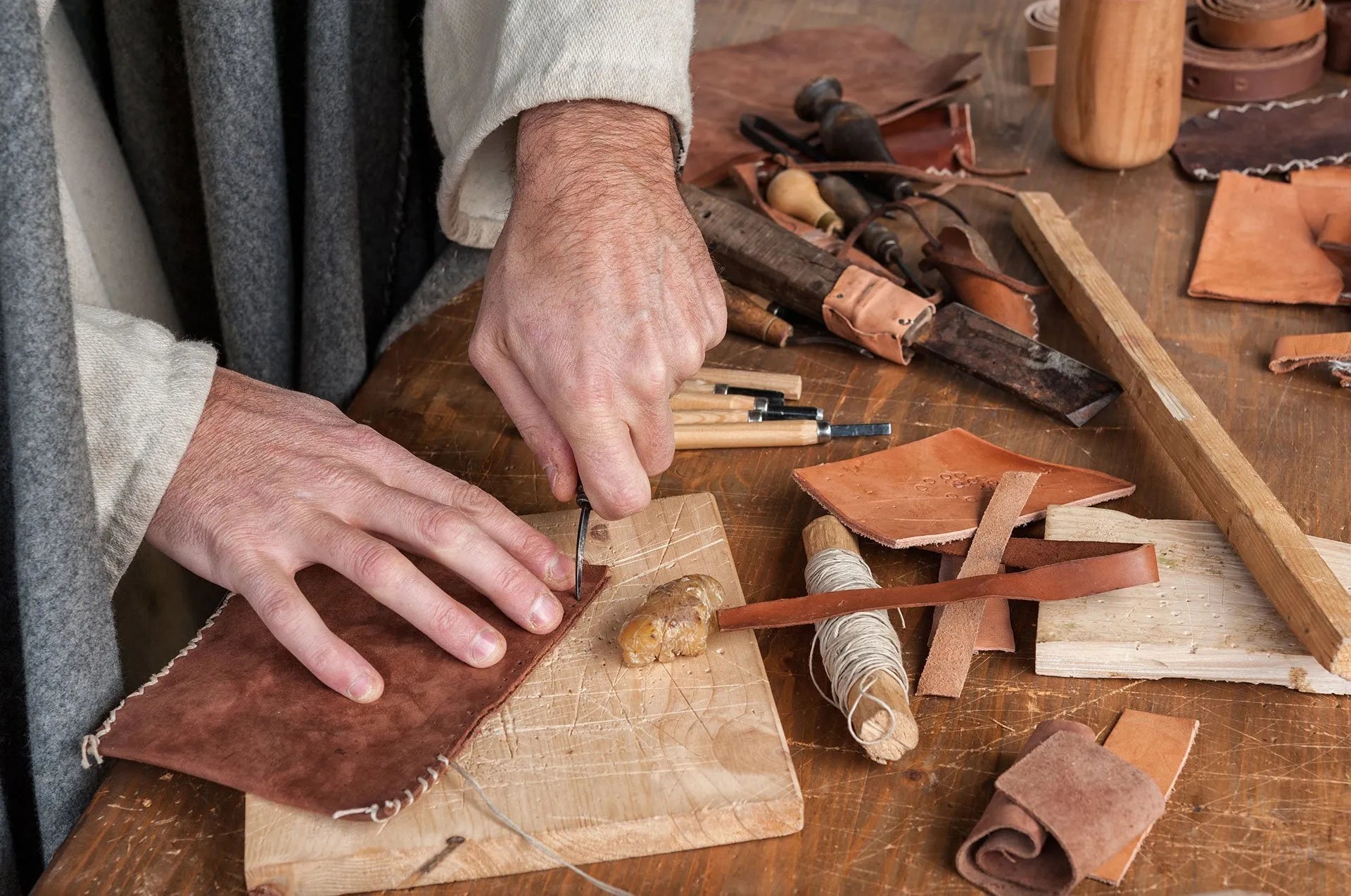
These are not surface-level skills. They involve a deep understanding of material properties. Artisans evaluate hides by touch, weight, elasticity, and natural markings. They match grain patterns by hand to ensure visual and structural harmony. They cut leather in alignment with its natural fiber direction to prevent warping. They use edge paints, adhesives, stitching techniques, and reinforcements that respond to the specific characteristics of each hide.
This process is deliberate. It is rooted in the belief that quality cannot be divorced from time, human judgment, and respect for material integrity. Italian craftsmanship is not defined by geography alone. It is defined by a disciplined methodology that elevates raw materials into structurally sound and aesthetically refined goods.
Tanneries and workshops in Tuscany and Lombardy are often multigenerational, with skills passed down like heirlooms.
The Limits of Mass Production
Mass manufacturing is engineered around a different value system with a purpose of reducing time per unit, increasing volume, and lowering cost. Automated cutting machines optimize yield by slicing as many shapes as possible from a hide, even if that means cutting across weaker fiber sections. Leathers are often split, corrected, or heavily coated to mask imperfections so they can withstand rapid processing. Stitch lines are optimized for speed rather than load-bearing strength.
These choices do not inherently undermine a product but they do impose constraints. Uniformity becomes the priority, even if it requires heavily treated materials. Cost targets influence hardware selection, lining durability, and reinforcement techniques. The result is often a product that appears polished at first sight yet lacks the underlying structure required for long-term performance.
This system works for high-volume categories, but it is not designed to produce heirloom-level goods. Instead, it maximizes accessibility and reduces replacement friction. The trade-off is lifespan.
Time, Intention, and the Human Hand
The most important distinction between artisanal craftsmanship and mass manufacturing is the role of human discretion. An experienced craftsperson evaluates each hide individually and adjusts stitch tension based on thickness variation. They bevel edges differently depending on grain density and reinforce stress points with techniques learned through years of trial and repetition. These micro-decisions cannot be fully automated because they depend on tactile intelligence and material fluency.
Handcrafted luxury carries an emotional and functional presence that reflects this labor. Over time, the leather develops a patina that mirrors the wearer’s habits. The structure holds, the edges resist splitting and the bag softens without collapsing. These outcomes are not aesthetic accidents. They are the combined result of human skill, thoughtful engineering, and deliberate pacing.
Material Integrity and Why It Matters
The foundation of any leather product is the hide itself. Italian workshops tend to work with full grain and top grain leathers sourced from regulated, traceable suppliers. These leathers preserve the natural fiber matrix of the hide, which determines strength, flexibility, and aging behavior. They absorb color more naturally, retain oils that prevent cracking, and evolve in appearance over time.
Mass production often uses split leather or corrected grain because they are more available and easier to standardize. These leathers are mechanically altered, heavily coated, or reconstructed from lower layers of the hide. While initially smooth, they are more vulnerable to peeling, cracking, and warping because the structural fibers have been weakened or removed.
Material quality is not a subtle distinction. It is the core determinant of longevity.
Longevity Is the Real Value
When evaluating a luxury piece, the most revealing metric is cost per wear. A well-made Italian leather bag may require a higher initial investment, yet it can remain functional and visually compelling for a decade or longer. Repairs, conditioning, and proper care can extend its usefulness even further. Many pieces become family items passed between generations.
By contrast, mass-produced bags are optimized for affordability and trend cycles. Their lifespan is intentionally shorter, not designed to accumulate years of wear or retain structural resilience. The economic value is different because the design philosophy is different. Durability is the true indicator of worth.
Sustainability Through Quality and Resource Stewardship
Sustainability discussions often focus on materials or manufacturing emissions, but longevity is a critical variable.
A single well-crafted leather bag reduces the need for multiple replacements, lowering long-term material consumption and waste generation.
Many Italian tanneries operate under EU environmental regulations that require closed-loop water systems, chemical controls, and traceability audits. Workshops tend to produce in smaller volumes and adhere to slower production cycles.
Mass manufacturing multiplies environmental impact through scale. Even a modest defect rate, when applied to millions of units, results in significant waste. Shortened product lifespans further accelerate disposal and replacement. The sustainability cost is not only what is produced but how often it must be replaced.
Quality naturally aligns with lower long-term environmental impact.
Why Luxury Still Matters Today
The role of luxury in the modern market is shifting. It is no longer defined purely by exclusivity or aesthetics. Increasingly, consumers view luxury as an investment in craftsmanship, longevity, and cultural heritage. It represents an alternative to the disposability embedded in much of contemporary fashion.
Luxury craftsmanship remains relevant because it offers something irreplaceable: a human-centered approach to design and construction. It reflects the expertise of artisans who treat materials with intention, honor technical traditions, and build objects meant to accompany their owners through many phases of life. This is what sustains luxury’s value over time. Luxury is beyond a transaction; it is a relationship between the maker, materials, and the wearer.

FAQ Section
Is Italian craftsmanship really better?
Italian artisans tend to work with higher-grade materials and apply advanced techniques that preserve structural integrity and enhance aging. Their processes reflect deep technical knowledge developed over decades.
Why does luxury cost more?
Luxury pricing reflects the cumulative cost of premium raw materials, specialized labor, slower production cycles, and rigorous quality control. These factors extend a product’s lifespan and improve functional performance.
Are mass-produced bags always lower quality?
Mass production varies in quality, but its priorities differ from those of artisanal craftsmanship. The focus on speed and volume often results in material and construction compromises.
How long should a well-crafted Italian leather bag last?
With proper care, many handcrafted Italian leather bags last for more than ten years. Some become heirlooms passed down across generations.
Is luxury more sustainable than mass production?
When pieces are designed to last, they naturally reduce waste. High-quality craftsmanship supports longevity and minimizes the cycle of constant replacement.




Leave a comment
This site is protected by hCaptcha and the hCaptcha Privacy Policy and Terms of Service apply.